Media Summary: First we'll review weighted averages of two points and extend the idea to Now you are ready to start subdividing your own shapes with more than 4 points! Watch the next lesson: ... Next let's extend the averaging step from the previous lesson to include multiple points. Now we'll need to calculate positions ...

3 Fun With Weights Character Modeling Computer Animation Khan Academy - Detailed Analysis & Overview

First we'll review weighted averages of two points and extend the idea to Now you are ready to start subdividing your own shapes with more than 4 points! Watch the next lesson: ... Next let's extend the averaging step from the previous lesson to include multiple points. Now we'll need to calculate positions ... Now let's think about how subdivision would work in First we need to make sure we understand exactly what happens in the split & average steps. Watch the next lesson: ... How can we calculate a weighted average between two points? (pssst. This video is super important) Watch the next lesson: ...

How did Rob start out? Watch the next lesson: ... Now it's your turn to drive. In this video we'll present you with a casting challenge to complete using everything we've learned so ... Bonus! In this video we'll connect the degree of these curves to the number of control points in the construction. Watch the next ... Let's review the multiplication principle which allows us to quickly count the number of possible robots. Watch the next lesson: ... Now you can start scaling your shapes to make your lamp look younger Watch the next lesson: ... Let's apply what we just learned to calculate the touching point. Watch the next lesson: ...

Okay we know how to calculate the touching point, great! Next let's think about how we can prove this is true. Watch the next ... Now we can combine split and average into a single operation called subdivide. Watch the next lesson: ... Use an array to store many objects as well as create any shape you can imagine. Click here to review objects. Watch the next ...

Photo Gallery

3. Fun with weights | Character modeling | Computer animation | Khan Academy
1. Weighted average of three points | Character modeling | Computer animation | Khan Academy
3. Subdividing your own designs | Character modeling | Computer animation | Khan Academy
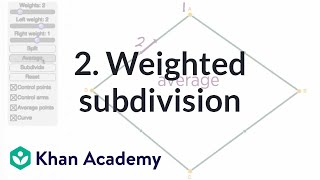
2. Weighted subdivision | Character modeling | Computer animation | Khan Academy
Math meets artistry | Animation | Computer animation | Khan Academy
4. Subdivision in 3D | Character modeling | Computer animation | Khan Academy
1. Split vs. average | Character modeling | Computer animation | Khan Academy
1. Weighted average of two points | Environment modeling | Computer animation | Khan Academy
Getting to know Rob Jensen | Animation | Computer animation | Khan Academy
5. Casting challenge | Crowds | Computer animation | Khan Academy
4. What degree are these curves? | Animation | Computer animation | Khan Academy
2. Robot combinations | Crowds | Computer animation | Khan Academy
Sponsored
Sponsored
View Detailed Profile
3. Fun with weights | Character modeling | Computer animation | Khan Academy

3. Fun with weights | Character modeling | Computer animation | Khan Academy

Let's take a closer look at the

1. Weighted average of three points | Character modeling | Computer animation | Khan Academy

1. Weighted average of three points | Character modeling | Computer animation | Khan Academy

First we'll review weighted averages of two points and extend the idea to

Sponsored
3. Subdividing your own designs | Character modeling | Computer animation | Khan Academy

3. Subdividing your own designs | Character modeling | Computer animation | Khan Academy

Now you are ready to start subdividing your own shapes with more than 4 points! Watch the next lesson: ...

2. Weighted subdivision | Character modeling | Computer animation | Khan Academy

2. Weighted subdivision | Character modeling | Computer animation | Khan Academy

Next let's extend the averaging step from the previous lesson to include multiple points. Now we'll need to calculate positions ...

Math meets artistry | Animation | Computer animation | Khan Academy

Math meets artistry | Animation | Computer animation | Khan Academy

Watch the next lesson: ...

Sponsored
4. Subdivision in 3D | Character modeling | Computer animation | Khan Academy

4. Subdivision in 3D | Character modeling | Computer animation | Khan Academy

Now let's think about how subdivision would work in

1. Split vs. average | Character modeling | Computer animation | Khan Academy

1. Split vs. average | Character modeling | Computer animation | Khan Academy

First we need to make sure we understand exactly what happens in the split & average steps. Watch the next lesson: ...

1. Weighted average of two points | Environment modeling | Computer animation | Khan Academy

1. Weighted average of two points | Environment modeling | Computer animation | Khan Academy

How can we calculate a weighted average between two points? (pssst. This video is super important) Watch the next lesson: ...

Getting to know Rob Jensen | Animation | Computer animation | Khan Academy

Getting to know Rob Jensen | Animation | Computer animation | Khan Academy

How did Rob start out? Watch the next lesson: ...

5. Casting challenge | Crowds | Computer animation | Khan Academy

5. Casting challenge | Crowds | Computer animation | Khan Academy

Now it's your turn to drive. In this video we'll present you with a casting challenge to complete using everything we've learned so ...

4. What degree are these curves? | Animation | Computer animation | Khan Academy

4. What degree are these curves? | Animation | Computer animation | Khan Academy

Bonus! In this video we'll connect the degree of these curves to the number of control points in the construction. Watch the next ...

2. Robot combinations | Crowds | Computer animation | Khan Academy

2. Robot combinations | Crowds | Computer animation | Khan Academy

Let's review the multiplication principle which allows us to quickly count the number of possible robots. Watch the next lesson: ...

3. Scale deformers | Rigging | Computer animation | Khan Academy

3. Scale deformers | Rigging | Computer animation | Khan Academy

Now you can start scaling your shapes to make your lamp look younger Watch the next lesson: ...

1. Creating objects | Rigging | Computer animation | Khan Academy

1. Creating objects | Rigging | Computer animation | Khan Academy

Before building

3. Compute the touching point | Environment modeling | Computer animation | Khan Academy

3. Compute the touching point | Environment modeling | Computer animation | Khan Academy

Let's apply what we just learned to calculate the touching point. Watch the next lesson: ...

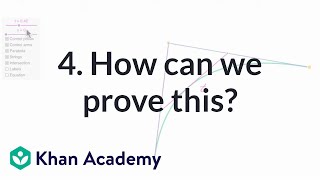
4. How can we prove this? | Environment modeling | Computer animation | Khan Academy

4. How can we prove this? | Environment modeling | Computer animation | Khan Academy

Okay we know how to calculate the touching point, great! Next let's think about how we can prove this is true. Watch the next ...

2. Subdivide operation | Character modeling | Computer animation | Khan Academy

2. Subdivide operation | Character modeling | Computer animation | Khan Academy

Now we can combine split and average into a single operation called subdivide. Watch the next lesson: ...

3. Putting shapes together | Rigging | Computer animation | Khan Academy

3. Putting shapes together | Rigging | Computer animation | Khan Academy

Use an array to store many objects as well as create any shape you can imagine. Click here to review objects. Watch the next ...