Media Summary: Please start with reviewing the Axioms for This video tutorial explains how to calculate the In 2022, In this video, I have clearly explained and solved problems of

Proof For The Probability Of A Complement - Detailed Analysis & Overview

Please start with reviewing the Axioms for This video tutorial explains how to calculate the In 2022, In this video, I have clearly explained and solved problems of A discussion of De Morgan's laws, in the context of basic In this tutorial you will learn about a very important concepts of Probability - Complementary Events. Again, simple dice ... An introductory discussion of unions, intersections, and

The probability of complementary event of complement of A is P(A) =1-P(A) Join this channel to get access to perks:

Photo Gallery

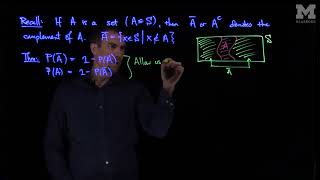
Proof for the Probability of a Complement
Prove that Probability of the Complement of A is One Minus the Probability of A
Probability of Complementary Events & Sample Space
The Probability of the Complement
Proof that if two events are independent, so are their complements.
L03.4 Independence of Event Complements
Complementation Law (Rule) Of Probability - Explained | Statistics Tutor
Derivation to Prove the Combination of Compliment Events are also Independent
Complement Rule for Probability (Example Included)
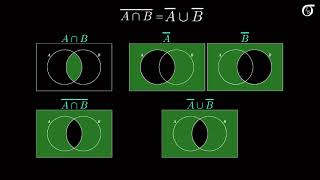
De Morgan's Laws (in a probability context)
Proof of P(A^c) = 1 - P(A)
Probability - What are Complementary Events
Sponsored
Sponsored
View Detailed Profile
Proof for the Probability of a Complement

Proof for the Probability of a Complement

Please start with reviewing the Axioms for

Prove that Probability of the Complement of A is One Minus the Probability of A

Prove that Probability of the Complement of A is One Minus the Probability of A

Prove

Sponsored
Probability of Complementary Events & Sample Space

Probability of Complementary Events & Sample Space

This video tutorial explains how to calculate the

The Probability of the Complement

The Probability of the Complement

We use the

Proof that if two events are independent, so are their complements.

Proof that if two events are independent, so are their complements.

Just getting warmed up. Here I

Sponsored
L03.4 Independence of Event Complements

L03.4 Independence of Event Complements

MIT RES.6-012 Introduction to

Complementation Law (Rule) Of Probability - Explained | Statistics Tutor

Complementation Law (Rule) Of Probability - Explained | Statistics Tutor

In 2022, In this video, I have clearly explained and solved problems of

Derivation to Prove the Combination of Compliment Events are also Independent

Derivation to Prove the Combination of Compliment Events are also Independent

Best Videos on Combination: ...

Complement Rule for Probability (Example Included)

Complement Rule for Probability (Example Included)

... the

De Morgan's Laws (in a probability context)

De Morgan's Laws (in a probability context)

A discussion of De Morgan's laws, in the context of basic

Proof of P(A^c) = 1 - P(A)

Proof of P(A^c) = 1 - P(A)

In this video I will going over a

Probability - What are Complementary Events

Probability - What are Complementary Events

In this tutorial you will learn about a very important concepts of Probability - Complementary Events. Again, simple dice ...

Computing Probabilities Through the Complement Event

Computing Probabilities Through the Complement Event

We compute the

Basics of Probability: Unions, Intersections, and Complements

Basics of Probability: Unions, Intersections, and Complements

An introductory discussion of unions, intersections, and

Prove De Morgan's Law in Set Theory Complement of Union is Intersection of Complements

Prove De Morgan's Law in Set Theory Complement of Union is Intersection of Complements

Prove

The probability of complementary event of complement of A is P(A) =1-P(A)

The probability of complementary event of complement of A is P(A) =1-P(A)

The probability of complementary event of complement of A is P(A) =1-P(A)

Probability Laws of Complementation

Probability Laws of Complementation

probability complement

Complement in Conditional Probability | P(A' | B) = 1 - P(A | B)

Complement in Conditional Probability | P(A' | B) = 1 - P(A | B)

Join this channel to get access to perks: https://www.youtube.com/channel/UCrOlfwSJ80gY4eZ6D2P_-Hw/join.
Proof of P(A ∪ B) = P(A) + P(B) - P(A ∩ B)

Proof of P(A ∪ B) = P(A) + P(B) - P(A ∩ B)

In this video I will going over a

Three Axioms for Probability (Definition of Probability)

Three Axioms for Probability (Definition of Probability)

1.